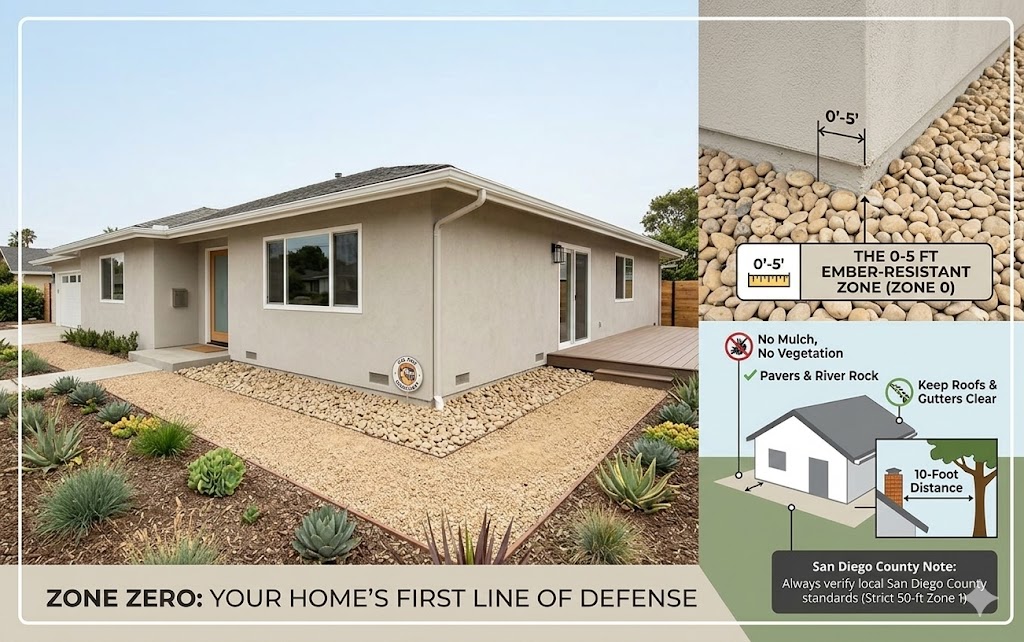
California has long required homeowners in wildfire-prone areas to create defensible space — cleared buffers around homes that reduce fire spread and give firefighters safer access. Now, the state is advancing a new, more intense set of requirements for the closest zone around a home known as Zone Zero.
Click here for Link to the official CAL FIRE Defensible Space page
or the California Board of Forestry
What Is Zone Zero?
(The 0-5 Foot Ember-Resistant Zone)
Zone Zero refers to the area from 0 to 5 feet immediately surrounding a home, attached decks, and other structures. It is the ember-resistant zone: the area most vulnerable to ignition from airborne embers during a wildfire.
California lawmakers passed legislation like AB 3074 (2020) and SB 504 (2024) directing the California Board of Forestry and Fire Protection to create formal Zone Zero regulations. An executive order from the governor requires the Board to complete rulemaking by the end of 2025, with phased implementation beginning as early as 2026.
Why Zone Zero Matters
Wildfire science shows that embers—not just flames—are a major cause of home ignition. Embers can travel miles ahead of the main fire and ignite combustible landscaping or materials right next to a home. The purpose of Zone Zero is to remove or replace those fuels so embers won’t find anything to burn as they land near structures.
Core Zone Zero Requirements
While final rules are still being refined, the draft and proposed standards give a strong picture of what homeowners will be required to do in the 0-5 ft perimeter:
1. Remove All Combustible Vegetation
- No shrubs, grass, leafy plants, or trees within 5 feet of any structure.
- Vegetation that can burn or drop embers (e.g., pine needles) must be eliminated.
2. Eliminate Combustible Mulch & Organic Ground Cover
- Wood mulch, bark chips, and similar materials are prohibited.
- Hardscaping using gravel, stone, pavers, or concrete is recommended.
3. Keep Structures Clear of Ember Fuel
- Remove combustible outdoor furniture, planters, firewood piles, and other items within the zone.
- Roofs and gutters must be free of leaves, needles, and debris.
4. Trim Tree Branches
- Live and dead tree branches must be removed if they’re within 10 feet of the roofline or above chimneys and stovepipes.
5. Replace Combustible Features
- Wooden fences, gates, attached trellises, and similar items that fall within the 5-foot buffer may need to be replaced with noncombustible materials.
6. Limited Exceptions (Draft)
Some proposals include conditions under which small potted plants may be allowed — if they are non-combustible, kept away from ignition sources, and sufficiently spaced from the home.
Where and When Zone Zero Applies
Applicable Areas
Zone Zero requirements are being developed to apply primarily in:
- State Responsibility Areas (SRA) — lands where the state oversees wildland fire protection.
- Very High Fire Hazard Severity Zones — high-risk areas identified by CAL FIRE and local agencies.
When Do the New California Wildfire Rules Take Effect?
Timeline
- Initial compliance may begin with new construction in 2026.
- Existing homes are expected to have a grace period of several years to meet full compliance once rules are finalized — likely into 2027–2029 for many properties.
Local jurisdictions may also adopt additional or stricter defensible space requirements, so homeowners should check with their local fire department.
How Zone Zero Fits With Other Wildfire Defensible Space
Zone Zero is just the first layer of defensible space:
- Zone 1 (5–30 feet) focuses on maintaining lean, clean, and green vegetation — trimmed, spaced, and watered to reduce fire intensity.
- Zone 2 (30–100 feet) focuses on reduced-fuel vegetation management across a broader perimeter.
Together, these zones create a graduated buffer that slows wildfire advance and improves safety.
How to Prepare Your Property for Zone Zero Now
Even before the final rules are adopted, homeowners can start adapting their properties:
- Use noncombustible landscaping materials within 5 feet.
- Remove combustible plantings and debris near roofs, walls, and decks.
- Store firewood and other fuels well away from structures.
- Work with landscape professionals familiar with wildfire mitigation.
These steps can reduce wildfire risk today and may save on insurance costs, as insurers increasingly look at defensible space compliance when underwriting policies.
Final Thoughts
Zone Zero is designed to make homes more fire resilient by eliminating fuels in the area most likely to catch embers and spread fire. While the rules continue to be finalized, the trend toward proactive wildfire mitigation is clear, and early preparation will benefit homeowners as implementation unfolds in the coming years. If you need financing to help improve your home or are interested in selling your property before these rules become mandatory, we can help.
Frequently Asked Questions: California Zone Zero
What is the “Zone Zero” requirement in California?
Zone Zero, also known as the Ember-Resistant Zone, is the first 5 feet immediately surrounding your home and any attached structures. The regulation requires removing combustible materials like wood mulch, bark, and most vegetation to prevent wind-blown embers from igniting the home.
When does Zone Zero become mandatory for existing homes?
While rules for new construction begin sooner, the California Board of Forestry and Fire Protection is currently finalizing the timeline for existing homes. Phased implementation and enforcement are expected to begin as early as 2026, with grace periods likely extending through 2027–2029 for many properties.
Can I have any plants within 5 feet of my house?
The goal is a “non-combustible” perimeter. Generally, shrubs, trees, and woody plants must be removed. Some draft exceptions may allow for very small, high-moisture plants in non-combustible containers (like ceramic pots), provided they are well-spaced and free of dead material.
Do I have to remove my wood mulch in Zone Zero?
Yes. Wood mulch and bark are highly combustible. For Defensible Space compliance, homeowners are encouraged to replace organic mulch with non-combustible alternatives like gravel, river rock, pavers, or decomposed granite (DG).
Does Zone Zero apply to my deck or fence?
Yes. Because decks and fences often act as “fuses” that lead fire directly to the house, the new rules will likely require that the area under and around decks be cleared of debris and that combustible fencing within 5 feet of the structure be replaced or modified.
Will local San Diego rules be different?
Possibly. Local jurisdictions, especially in Very High Fire Hazard Severity Zones within San Diego County, have the authority to implement stricter standards than the state minimum. Always check with your local fire department for specific regional updates.
BIOGRAPHY –
“Wildfire compliance isn’t just about safety—it’s about protecting your home’s equity. Contact Greg today to see how these new mandates affect your property value.”

award‑winning Sr. Mortgage Loan Officer with Point Mortgage, serving Southern California homebuyers.
Whether you’re buying, selling, refinancing, or building your dream home, you have a lot riding on your loan specialist. Since market conditions and mortgage programs change frequently, you need to make sure you’re dealing with a top professional who is able to give you quick and accurate financial advice. I have the expertise and knowledge you need to explore the many financing options available.
Ensuring that you make the right choice for you and your family is my ultimate goal. And I am committed to providing my customers with mortgage services that exceed their expectations. I hope you’ll browse my website, check out the different loan programs I have available, use my decision-making tools and calculators, and apply for a loan in just four easy steps with the short form Application.
After you’ve applied, I’ll call you to discuss the details of your loan, or you may choose to set up an appointment with me using my online form. As always, you may contact me anytime by phone, fax or email for personalized service and expert advice.

| Greg Gossard, 246668 Sr. Mortgage Loan Officer Point Mortgage Corporation |
| m: 858.212.5626 (LOAN) |
| ggossard@pointmtg.com |