

According to homeownership data by occupation, teachers and social service professionals have one of the highest homeownership rates in the United States—higher than many STEM and technology professions that earn substantially more.
That’s a problem for the popular narrative.
Because if the housing market were truly reserved only for high-income earners, teachers wouldn’t be near the top of the list.
The current narrative dominating news feeds and social media algorithms is loud, clear, and incredibly discouraging: “The American Dream is dead. Homeownership is completely out of reach for ordinary people.” If you listen to the noise, buying a house feels like an absolute mathematical impossibility today.
But when you look past the viral panic and dig into actual consumer data and housing history, a very different story emerges. A massive gap exists between the perception of affordability and the reality of what is actually happening in the market. The media has heavily distorted the path to homeownership—and letting that narrative dictate your financial future only benefits landlords and corporate hedge funds.
The data-driven reality shows why homeownership may be far more attainable than many people have been led to believe, and how the math actually stacks up in your favor compared to generations past.
The Teacher Paradox: Proof It’s About Strategy, Not Six Figures
If high prices and current interest rates truly made homeownership an elite privilege reserved only for the wealthy, then only top-tier earners would be buying houses. However, recent data completely busts that myth.
According to a study published by Visual Capitalist, which ranks homeownership rates by occupation, factors far beyond salary—like job stability and geographic distribution—are what truly shape who owns a home today. Using data from the National Association of Realtors and the U.S. Census Bureau, the study reveals a striking comparison of homeownership rates across different professions:
| Occupation | Homeownership Rate 2024 | Median Salary |
|---|---|---|
| Management & Business | 72.2% | $91,398 |
| Education & Social Services (Teachers) | 67.3% | $65,147 |
| STEM / Technical Professionals | 67.2% | $102,450 |
| Sales & Real Estate | 63.3% | $50,967 |
| Healthcare | 62.2% | $82,134 |
| Skilled Trades & Construction | 62.0% | $54,777 |
| Transportation & Public Safety | 58.1% | $46,975 |
| Service Occupations | 45.5% | $38,936 |
Look at those numbers closely. School teachers and social workers actually have a higher homeownership rate than tech and STEM workers, despite earning roughly $37,000 less per year on average.
What makes this interesting isn’t actually the affordability argument itself. It’s the contradiction.
If the public narrative says, “Normal working people can’t buy homes anymore,” then why are teachers sitting near the top of homeownership statistics? Teachers aren’t hedge fund managers. Teachers aren’t Silicon Valley millionaires. Teachers aren’t private equity executives. They’re teachers.
That fact alone forces people to ask a critical question: “What are they doing that I’m not?”
When teachers consistently outperform higher-income professions in homeownership rates, the conversation can no longer be about income alone. At some point, strategy, stability, timing, and financial decisions become part of the equation.
Homeownership rates don’t mean every teacher bought yesterday. Many purchased years ago, stayed in their homes, built equity, and benefited from long-term appreciation. Ironically, that reinforces the point. The people who succeed in housing are often the ones who stop treating it like a short-term investment and start treating it like a long-term wealth-building tool.
If Teachers Can Do It, What Are They Doing Differently?
Teachers generally aren’t buying homes because they’re wealthy. They’re buying because they tend to:
- Stay employed consistently.
- Build careers over decades.
- Utilize available housing programs.
- Buy for stability rather than speculation.
- Think long-term.
The lesson isn’t that housing is easy. The lesson is that homeownership has always been a long-term strategy, not a short-term transaction.
That ties the entire concept together. Because the core of the issue isn’t really about teachers. It’s about proving that the biggest predictor of homeownership isn’t always income. It’s planning, consistency, and understanding the tools available.
The “Cheap House” Illusion
One of the most common mistakes in housing discussions is comparing yesterday’s home prices to today’s home prices without comparing incomes, interest rates, and financing options.
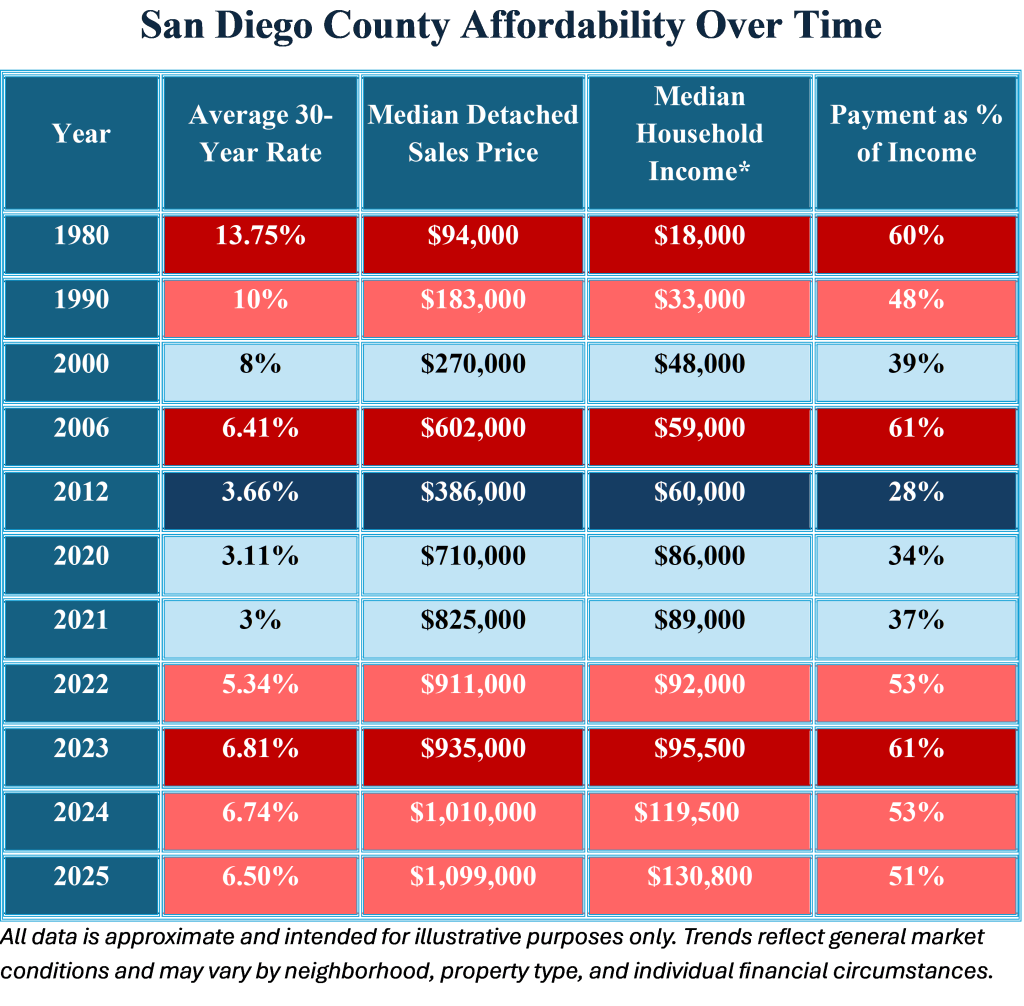
A $100,000 house in 1990 sounds incredibly affordable until you remember that median household income was roughly one-quarter of what many households earn today and mortgage rates frequently exceeded 10%.
The question isn’t: “How much did the house cost?”
The question is: “How much of the buyer’s paycheck did it consume?”
When viewed through that lens, many buyers today are surprised to discover that previous generations often devoted a larger percentage of their income to housing than modern headlines suggest.
The 1990s vs. Today: The Out-of-Pocket Reality
It’s easy to look back at the 1990s through a lens of nostalgia, assuming it was a golden era where homes were practically handed out for free. While sticker prices were lower, looking only at the purchase price ignores the true structural cost of buying a home “back in the day.”
When you run the math on what actually left a buyer’s pocket relative to their salary, modern buyers have distinct advantages:
- The Take-Home Pay Burden: In the 1990s, mortgage interest rates routinely sat between 7% and 10%, spiking even higher into the double digits at the turn of the decade. Financing a modest starter home at those rates meant that your monthly mortgage payment swallowed an incredibly steep, disproportionate chunk of your weekly paycheck. Buyers back then were often working the first two weeks of every single month just to pay the bank’s interest. Today, while purchase prices are higher, modern household earnings have also scaled significantly. In many cases, once income growth, financing flexibility, and lower down-payment requirements are factored in, the percentage of income required to enter the market may be closer to historical norms than many buyers realize.
- The Down Payment Hurdle: In the 1990s, a conventional 20% down payment was standard and largely expected to secure a competitive loan. Today, standard conventional loans require as little as 3% down, and FHA loans require just 3.5%. For a $400,000 home, that is the difference between needing a massive $80,000 cash stack upfront versus a manageable $12,000 to $14,000.
By parting with less upfront capital and leveraging higher modern earnings, today’s working professional keeps more of their liquidity intact. The path today allows you to protect your active cash flow in a way buyers thirty years ago could only dream of.
Expectations Inflation & The Identity Crisis of the Starter Home
Beyond the raw math, we are also dealing with a massive case of expectations inflation.
Back then, a first house meant:
- Formica countertops
- One bathroom
- No granite
- No stainless steel
- No open floor plans
- No remodeled kitchens
- No luxury vinyl plank flooring
- No Instagram-worthy design
Today’s buyers often compare their first home to someone’s third home.
The starter home hasn’t disappeared. What’s disappeared is our definition of a starter home. Many first-time buyers from previous generations purchased homes that needed work. They painted, repaired, upgraded, and slowly built equity over time. Today’s buyers are often comparing themselves to fully renovated properties showcased on social media and television.
The first home was never supposed to be the forever home. It was supposed to be the first step.
The Median Price Trap: A Real-World Example
Headlines often focus on median home prices, but medians can be misleading. In markets like San Diego County, properties sell across an enormous price spectrum—from modest condos and starter homes to luxury estates worth tens of millions of dollars.
The Timeline Shift: Delayed Milestones, Not Defeat
The media loves to point out that the median age of a first-time homebuyer has climbed to 40 years old, using it as definitive proof that the system is broken. But this narrative completely misses the forest for the trees.
People aren’t just buying homes later; society has shifted the timeline for every major life milestone:
- Delayed Marriage and Family: In 1990, the average age of marriage was roughly 24 for women and 26 for men. Today, those numbers have pushed back to 30 and 32. Because the single largest catalyst for buying a home has historically been marriage and starting a family, pushing those milestones back naturally moves the home-buying age into the late 30s and 40s.
- The Career and Salary Build: Entering the market later means modern buyers have spent an extra decade building advanced career skills, navigating income growth, and securing a much higher baseline salary. When they step into the market at 40, their household earning power is at its peak, making the modern mortgage payment a highly manageable percentage of their income.
Waiting until 40 isn’t a sign of generational failure—it’s a reflection of a generation that builds a massive foundation of lifetime earnings before settling down.
The “Perception Corruption”: Who Benefits When You Give Up?
Why is the internet so determined to convince you that you can’t buy a home? Because your defeatism is highly profitable for someone else.
In the 1990s, a buyer’s frame of reference was their local neighborhood, their coworkers, and the local paper. They bought a modest, often outdated starter home, painted it themselves, and expected to move in five years.
Today, social media feeds bypass the starter home entirely. Algorithms serve up curated, high-end content showing influencers buying pristine, fully upgraded luxury estates. This creates a “perception corruption.” It convinces young professionals that if their first home doesn’t look like a real estate reality TV show, they “can’t afford to buy.”
Whether intentional or not, the constant stream of headlines declaring homeownership impossible creates an environment that benefits institutional landlords, large investors, and corporate housing owners. The more people believe ownership is unattainable, the more likely they are to remain renters indefinitely.
When you buy into this negative media noise and give up, you make a conscious decision to rent. Renting comes with a built-in reality: your housing payment can increase repeatedly over time. A fixed-rate mortgage, by contrast, locks the principal and interest portion of your payment for decades. Every rent payment builds someone else’s equity rather than your own. That choice directly funds a landlord’s retirement and expands corporate portfolios.
This is where the real danger lies. If people accept that something is impossible, they stop looking for solutions. They stop talking to lenders. They stop researching assistance programs. They stop exploring different neighborhoods. They stop running the numbers.
At that point, they become permanent renters by default.
Challenging the assumption that it’s impossible is the most crucial step. Leading with the evidence—like the homeownership rates of everyday teachers—is what changes minds, because real evidence is what dismantles speculation.
Renting vs. Buying: The Cost of Waiting
While media reports may highlight a median price near $900,000, buyers are still purchasing homes, condos, and townhomes at significantly lower price points every day. That directly addresses one of the biggest psychological traps buyers fall into: looking at a single headline summary and assuming it represents every square mile of the local map.
To illustrate how the math plays out over time, let’s look at a typical breakdown of renting a home versus buying a home in today’s market. Many people stay in a rental because the initial monthly payment looks slightly lower than a mortgage payment.
| Year | Monthly Rent (Est. 5% Annual Increase) | Fixed Mortgage Payment (Principal & Interest) | Equity Built by Owning |
|---|---|---|---|
| Year 1 | $2,500 | $2,800 | You begin reducing loan balance immediately. |
| Year 3 | $2,756 | $2,800 | Property appreciates; equity grows. |
| Year 5 | $3,038 | $2,800 | Rent now permanently exceeds the mortgage. |
| Year 10 | $3,877 | $2,800 | Massive wealth gap created. |
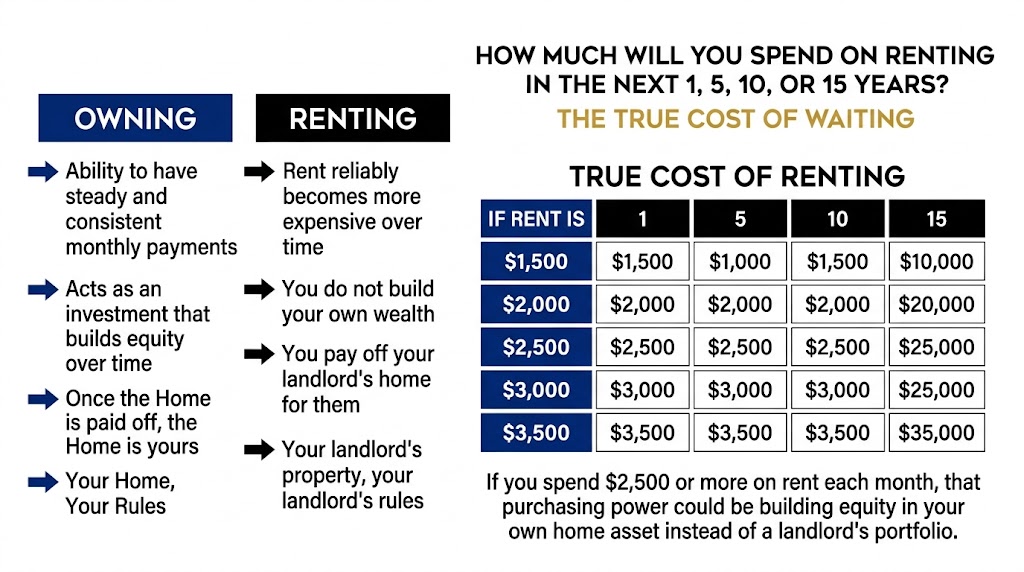
Over a ten-year window, the renter has handed over hundreds of thousands of dollars to a landlord, walked away with zero assets, and faces a skyrocketing monthly payment. Meanwhile, the homeowner stabilized their biggest monthly expense, watched their property appreciate, and built massive personal net worth.
The Modern Toolkit: Bridging the Affordability Gap
The reason so many everyday families are successfully buying homes today is that they aren’t trying to do it the old-fashioned way. They are leveraging an entirely new financial toolkit engineered to lower the barrier to entry:
- Down Payment Assistance (DPA) Programs: State and local housing finance agencies offer massive support to buyers. Programs like the GSFA Platinum program provide down payment grants and silent second mortgages that can cover a buyer’s entire down payment and closing costs, minimizing the cash needed from your own pocket.
- First-Time Homebuyer Grants: Federal and state initiatives, including CalHFA programs, offer specialized loan structures tailored specifically to low- and moderate-income workers—ensuring that vital community pillars like teachers, healthcare workers, and civil servants can root themselves in the communities they serve.
- The “Buy the House, Refinance the Rate” Strategy: Savvy buyers know that you marry the house and date the rate. By purchasing a home now when competition is lower due to negative media noise, you build equity immediately and retain the option to refinance into a lower interest rate when the market cycles down.
Conclusion: Change Your Information, Change Your Future
The data proves that homeownership is happening right now for everyday working professionals who tune out the noise, look at the actual math, and leverage modern low-down-payment options.
The greatest obstacle facing many potential homeowners isn’t always income, interest rates, or inventory. Sometimes it’s the belief that ownership is impossible before they ever explore their options.
The teachers, nurses, tradespeople, public employees, and working families who are buying homes every day prove otherwise. Change your information, and you may change your future.
Footnote. Think California is more expensive to live in than other states? This may surprise you.
The Hidden Costs of Moving: Why Leaving California for “Cheaper” States May Not Save You Money
Let’s Talk Housing: Common Myths vs. Facts
Question 1: If the housing market is so unaffordable, why do teachers have such high homeownership rates?
Answer 1: While media narratives focus entirely on a single six-figure income requirement, data from the National Association of Realtors and the U.S. Census Bureau shows that long-term homeownership is heavily driven by job stability, career longevity, and strategic planning. Teachers and social workers frequently utilize localized down payment assistance programs and view housing as a stable, long-term wealth-building step rather than a short-term financial speculation.
Question 2: Was buying a home in the 1990s significantly easier than it is today?
Answer 2: While sticker prices were lower in the 1990s, mortgage interest rates routinely sat between 7% and 10%, meaning a massive chunk of a buyer’s monthly paycheck went entirely to bank interest. Additionally, previous generations faced strict 20% down payment expectations. Today’s market offers distinct structural advantages, including low-down-payment options (3% to 3.5%) and flexible financing programs that help working professionals keep their liquid cash intact
Question 3: How does the long-term math look when comparing renting to a fixed mortgage?
Answer 3: Although renting might initially show a slightly lower monthly cost, rents historically climb by an average of 5% annually. Within a 5-to-10-year window, those compounding rent increases typically surpass what would have been a stable, fixed-rate mortgage payment. While a renter builds zero assets and funds a landlord’s retirement, a homeowner caps their largest monthly living expense and steadily builds massive personal net worth through home equity.
If teachers can achieve one of the highest homeownership rates in America, despite earning substantially less than many higher-income professions, maybe the conversation we’ve been having about housing is incomplete.
Ready to Move Past the Headlines?
Don’t let corporate landlords and media panic dictate your financial future. If you are ready to explore your options, look at real local inventory, and build a stable 5-to-10-year housing plan, we are here to help.
Connect with Brad and Karen Mattonen at HomesInSDCounty. No pressure, no lifestyle sales pitches—just data, strategy, and honest advice.
⭐ Why Work With Us?
✔️ We ensure your sale or purchase is handled legally, safely, and strategically
✔️ We help you avoid costly mistakes that most buyers and sellers never see coming
✔️ We actively protect your interests while working to maximize your outcome
✔️ We’re not here for fluff—we’re here to deliver results with integrity
✔️ Clear guidance so you can make confident, informed decisions
💼 HomesinSDCounty: Local Power. Nationwide Reach.
✅ Experts in Probate, Pre-Foreclosure & Distressed Sales
✅ Strategic Advisors in Residential, Investment & Commercial Real Estate
✅ No fluff. Just relentless advocacy and smart protection.
🎥 Watch more San Diego neighborhood and real estate videos:
👉 https://www.youtube.com/@homesinsandiegocounty
💥 Explore Our Valuable FREE Real Estate Resources
✓ eBooks | ✓ Checklists | ✓ Buying & Selling Guides | ✓ Investor Tools
→ Visit our Resources Page to download now
🚀 Work With Us Today
📲 Call/Text: 858-518-2875
📧 Email: [email protected]
🌐 HomesInSDCounty.com
👉 Get a custom strategy based on your real estate goals—buying, selling, or investing.
👉 Follow us for market updates & local insights
- 👤 Facebook: North County SD Home Sales
- 📸 Instagram: @sandiegocountyhomes
- 📌 Pinterest: San Diego Living & Real Estate
- 🎵 TikTok: @homesinsandiegocounty
- 🐦 X (Twitter): @SDHomesForSale
- 💼 LinkedIn: Brad Mattonen – Professional Insights
- 📺 YouTube: Subscribe for Weekly Updates
🛠️ Selling Your Home? Ask Us About RealVitalize
If you need to make improvements, repairs, or updates before you sell—but don’t want to pay upfront costs—RealVitalize is your solution.
Our RealVitalize program provides:
- ✅ Professional repairs, updates, and home improvement services
- ✅ No upfront out-of-pocket costs, hidden fees, or interest charges
- ✅ Seller pays back only the amount used—at closing
- ✅ Services available before or during your home listing period
- ✅ Designed to highlight your home’s best features and maximize value
We’ll help you prep your home for sale with zero stress and maximum impact.
📲 Contact us today to learn how RealVitalize can work for you.
Protect your home. Protect your tax savings. Protect your family’s future.
@sandiegocountyhomes YouTube: @homesinsdcounty #SolanaBeach #SanDiegoRealEstate #CoastalLiving #NorthCountySanDiego #MarketUpdate #RealEstateTips #HomesInSDCounty #BradAndKarenMattonen #RightSizing